
Introduction
There’s a reason wynonna judd performance reactions feel louder than usual right now: people aren’t just watching her sing—they’re judging how a legend is supposed to behave on stage. And when she doesn’t match that expectation, the conversation turns fast.
She hasn’t lost her voice. That part is clear. What’s changed is how she carries it.
The voice is still there, and that’s what complicates everything
If wynonna judd performance reactions were purely about vocal decline, this wouldn’t even be a discussion. But that’s not what’s happening. Her voice still cuts through a room the way it always did—thick, textured, unmistakable.
That’s exactly why the reactions are so divided.
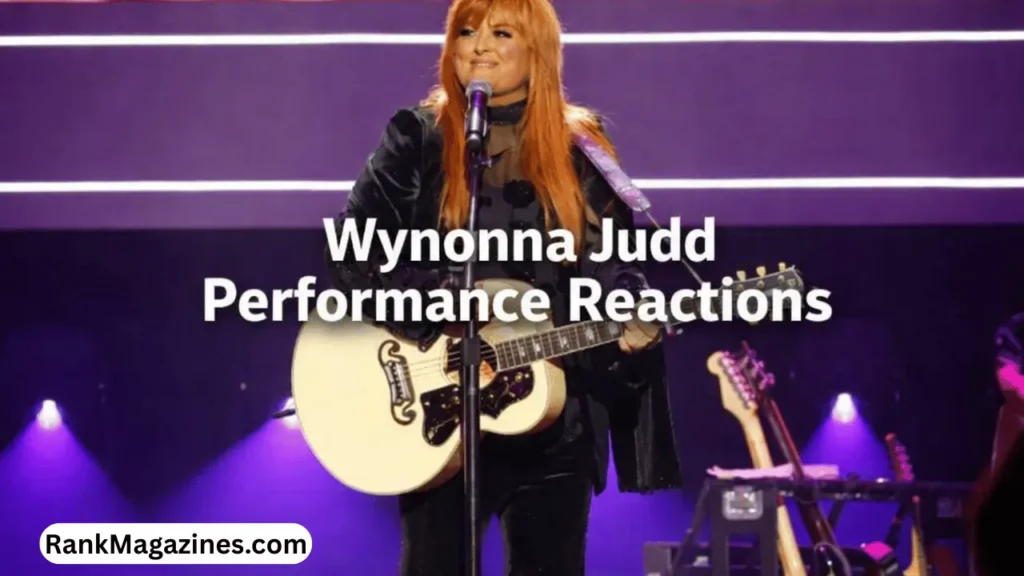
Fans walk into her shows expecting a full-package performance: movement, energy, command. Instead, they’re getting something more restrained. Sometimes she stands still. Sometimes she leans into the microphone like the weight of the song is physical.
And that contrast—powerful voice, limited movement—is what drives most wynonna judd performance reactions online.
Some call it raw. Others call it off.
When stillness on stage becomes the headline
There was a time when standing still on stage signaled control. Now it gets interpreted as something being wrong. That shift in audience expectation is at the center of recent wynonna judd performance reactions.
At certain performances, viewers noticed her gripping onto nearby performers or staying rooted in one position. Clips spread quickly. Comments followed even faster.
People didn’t ask, “How does she sound?”
They asked, “Is she okay?”
That says more about modern audiences than it does about her.
Wynonna later pushed back on the concern, pointing to nerves rather than health issues. But once wynonna judd performance reactions take on a life of their own, explanations rarely catch up.
The emotional weight behind recent performances
You can’t separate wynonna judd performance reactions from what she’s been through personally. That context doesn’t excuse everything—but ignoring it makes the reactions feel shallow.
Performing after loss changes a performer. It strips away polish. It replaces confidence with something heavier.
And that shows up on stage.
There are moments where her delivery feels less like a performance and more like processing something in real time. Not every audience is comfortable with that. Some came for nostalgia, not vulnerability.
So the same moment—her pausing, holding a note longer than expected, closing her eyes—splits wynonna judd performance reactions into two camps:
- those who see honesty
- those who see discomfort
Neither side is completely wrong, but one is definitely less patient.
Why collaborative performances land better
Put Wynonna next to other artists, and the tone of wynonna judd performance reactions shifts almost instantly.
Collaborations soften the scrutiny. They redistribute attention. They also give her space to interact instead of carrying the entire emotional load alone.
At major festival appearances, where she shares the stage with newer acts, the energy feels different. More fluid. Less pressure on every single movement.
And the reactions reflect that.
Instead of dissecting her posture, fans talk about chemistry. Instead of questioning her energy, they focus on the moment.
It’s not that she performs better in collaborations. It’s that audiences judge her less harshly when she’s not standing alone under a spotlight built on decades of expectation.
The nostalgia problem no one wants to admit
A big part of wynonna judd performance reactions has nothing to do with the present. It’s about memory.
People remember how she used to move, how she used to command a stage, how effortless it all seemed. And they bring that version of her into every new performance.
That’s an unfair standard, but it’s a real one.
Legacy artists don’t just compete with their peers. They compete with their own past.
And the audience rarely adjusts their expectations accordingly.
So when Wynonna chooses stillness over movement, or emotion over precision, it clashes with the version fans have already decided is “correct.”
That tension fuels almost every polarized wynonna judd performance reactions thread you’ll find online.
Social media turned small moments into big narratives
A single clip can define an entire performance now. That’s another reason wynonna judd performance reactions feel amplified.
A few seconds of her holding onto someone’s arm becomes a story about instability. A paused lyric becomes a sign of struggle.
But live shows aren’t built for clips. They’re built for presence, atmosphere, and continuity.
When you reduce a full performance to a short moment, you lose context—and wynonna judd performance reactions suffer because of it.
People react to fragments, not the full experience.
And fragments are easy to misread.
Not all criticism is unfair—but some of it is lazy
Let’s be clear: not every negative take in wynonna judd performance reactions is wrong.
There are valid points.
Some performances do feel uneven. Some moments look uncertain. Some choices don’t land the way they’re intended to.
But there’s a difference between critique and assumption.
Saying a performance lacked energy is fair. Jumping straight to health speculation based on a clip isn’t.
Unfortunately, the louder side of wynonna judd performance reactions often leans toward assumption.
That’s what turns discussion into noise.
What audiences actually want—but won’t say directly
Most wynonna judd performance reactions circle around one unspoken demand: consistency.
Fans want to know what version of her they’re going to get.
- The powerhouse vocalist who dominates the stage
- The reflective performer who stands still and lets the song breathe
- The collaborative artist who feeds off others
Right now, she moves between all three.
That unpredictability keeps things interesting—but it also unsettles audiences who came expecting something specific.
And when expectations aren’t met, reactions get sharper.
The bigger shift: performance vs presence
What’s really happening beneath all these wynonna judd performance reactions is a shift in how people define a “good performance.”
For years, it meant movement, energy, and control.
Now, artists are leaning into presence. Stillness. Emotion. Imperfection.
Wynonna seems to be moving in that direction—intentionally or not.
The problem is, her audience hasn’t fully moved with her.
So every performance becomes a kind of negotiation between what she’s offering and what people expected to receive.
She’s not trying to be who she was—and that’s the point
This is where most wynonna judd performance reactions miss the mark.
They assume she’s failing to recreate something.
But what if she’s not trying to?
There’s a difference between decline and change. And right now, she looks more like someone choosing a different way to perform rather than someone struggling to keep up.
That doesn’t mean every show works. It doesn’t mean every reaction is wrong.
But it does mean the conversation needs to catch up to what she’s actually doing on stage.
Because judging her against a version of herself that no longer exists isn’t criticism—it’s nostalgia refusing to evolve.
Conclusion
Wynonna Judd isn’t putting on the kind of performances people remember. She’s doing something riskier—letting the performance reflect where she is now, not where she used to be. That’s why wynonna judd performance reactions feel so split. Some people see honesty. Others see something missing.
The real question isn’t whether she’s still great. It’s whether audiences are willing to accept a version of greatness that doesn’t look the same anymore.
FAQs
1. Why are wynonna judd performance reactions so mixed lately?
Because her performances combine strong vocals with a more restrained stage presence, which clashes with what long-time fans expect.
2. Did Wynonna Judd address concerns about her performances?
Yes, she has responded to concerns by explaining that certain moments were due to nerves rather than health issues.
3. Are her vocals still strong in recent performances?
Consistently, yes. Even critical wynonna judd performance reactions often admit her voice remains powerful.
4. Why do collaborative performances get better reactions?
Sharing the stage reduces pressure and shifts audience focus, leading to more positive wynonna judd performance reactions.
5. Is social media affecting how people view her performances?
Absolutely. Short clips often lack context, which leads to exaggerated or misleading wynonna judd performance reactions.
You May Also Read: Delta Flight Dl275 Diverted LAX: What Really Happened Mid-Flight and Why It Matters