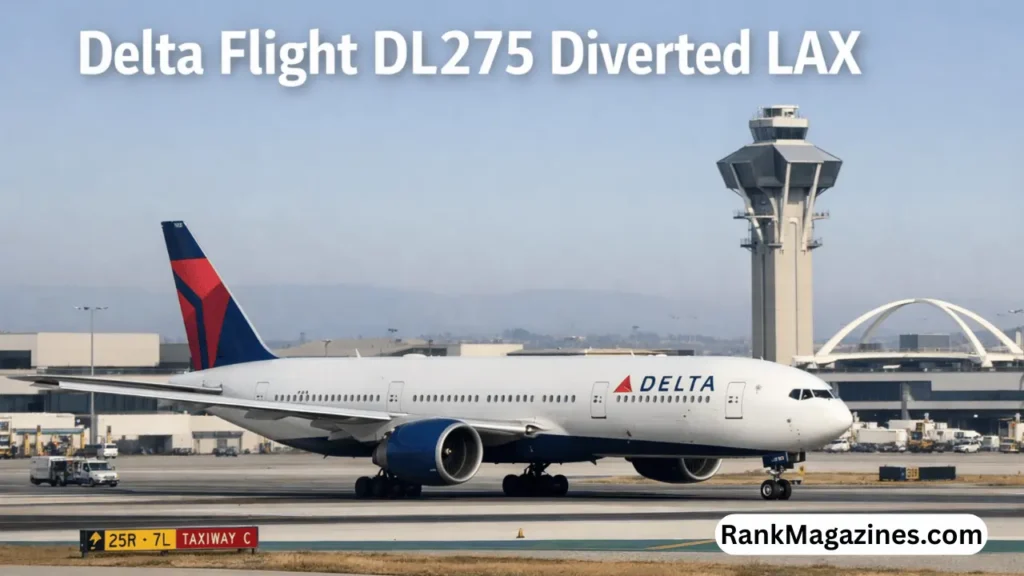

Introduction
There’s a tendency to treat flight diversions as dramatic, rare events. That’s the wrong lens. What happened with delta flight dl275 diverted lax wasn’t chaos in the sky—it was a controlled, calculated move that shows how modern aviation actually works when things stop being routine.
The story isn’t about panic. It’s about judgment under pressure, and why a long-haul flight that was already deep into its journey still turned around and headed for Los Angeles.
A long-haul flight that didn’t go as planned
Delta flight dl275 diverted lax began as a standard intercontinental trip from Detroit to Tokyo Haneda. On paper, nothing about it stood out. The aircraft, an Airbus A350-900, is one of the most advanced long-haul jets in service. The route is well established. The airline runs it regularly.
But somewhere over the Pacific, the situation shifted.
The issue wasn’t visible to passengers in any obvious way. No turbulence, no sudden drop, no alarming announcement. Inside the cockpit, though, the crew was dealing with a system problem tied to the engine anti-ice function. That’s not a minor detail. At cruising altitude, ice buildup can quietly compromise engine performance in ways that escalate fast.
So delta flight dl275 diverted lax became the safest option—not the most convenient one.
The anti-ice system failure wasn’t optional to ignore
It’s easy to underestimate something like an anti-ice system malfunction. After all, the engines were still running. The aircraft wasn’t in immediate danger. But long-haul aviation isn’t about reacting to failure—it’s about avoiding the conditions where failure becomes unavoidable.
At high altitude, ice accumulation can interfere with airflow into the engines. That can lead to compressor stalls or uneven thrust. Neither of those scenarios is something pilots gamble with over the Pacific Ocean.
That’s why delta flight dl275 diverted lax wasn’t treated as a “wait and see” situation. The crew had to assume the problem could worsen, especially as environmental conditions changed along the route.
Continuing to Tokyo would have meant committing to several more hours with reduced system reliability. That’s a risk professional pilots are trained not to take.
Why Los Angeles made more sense than turning back
One of the more interesting parts of delta flight dl275 diverted lax is the choice of diversion airport. Turning back to Detroit might seem logical at first glance, but it wasn’t.
By the time the issue was assessed, the aircraft had already crossed a significant portion of the route. Going back would have taken longer than moving forward to a major hub on the West Coast.
Los Angeles offered three things that mattered more than distance:
- Maintenance capability for a widebody aircraft
- Long runways designed for heavy jets
- Immediate operational support for passengers and crew
Delta flight dl275 diverted lax wasn’t just about landing safely. It was about landing somewhere that could handle what came next—repairs, rebooking, and aircraft inspection without delay.
Inside the cockpit: decisions that don’t get second chances
Pilots don’t get to crowdsource decisions. When delta flight dl275 diverted lax became necessary, the crew had to rely on training, data, and experience.
There’s a sequence to these situations:
First, identify the system fault and confirm it’s not a false alert.
Second, evaluate how that fault could evolve over time.
Third, consider the nearest viable airports—not just geographically, but operationally.
What matters here is timing. Wait too long, and options shrink. Act too early, and you disrupt hundreds of passengers unnecessarily. The balance is everything.
In the case of delta flight dl275 diverted lax, the crew acted at the point where risk began to outweigh continuation. Not before. Not after.
The passenger experience: confusion without danger
From the cabin, delta flight dl275 diverted lax likely felt abrupt rather than alarming. That’s typical. Airlines don’t broadcast every technical detail mid-flight, and for good reason.
Passengers were informed of a diversion, but not given a deep mechanical explanation. What they experienced instead was the practical side of the decision:
- A long delay upon landing
- Rebooking logistics
- Overnight accommodations for some travelers
No injuries were reported. No emergency evacuation. No visible crisis.
That disconnect—between what’s happening technically and what passengers perceive—is part of why events like delta flight dl275 diverted lax get misunderstood. Calm cabins don’t mean trivial problems.
The cost of playing it safe
Flight diversions aren’t cheap. Delta flight dl275 diverted lax reportedly carried a cost in the millions when you factor in fuel dumping, landing logistics, passenger compensation, crew adjustments, and aircraft downtime.
But here’s the reality: the cost of not diverting would have been far higher if the issue escalated.
Airlines don’t make these calls lightly. Every diversion hits schedules, finances, and customer satisfaction. Yet delta flight dl275 diverted lax still happened because safety decisions override operational efficiency every time.
That’s not a slogan. It’s enforced by both regulation and industry culture.
What happened after landing matters just as much
Once delta flight dl275 diverted lax touched down, the situation shifted from airborne risk to ground investigation.
The aircraft didn’t go back into service immediately. Maintenance teams inspected the anti-ice system, confirmed the fault, and carried out repairs. That process grounded the plane for hours.
Passengers were rerouted. Some continued their journey the same day. Others had to wait.
This phase rarely gets attention, but it’s where airlines prove whether they can recover from disruption. Delta flight dl275 diverted lax wasn’t just about a safe landing—it was about managing the aftermath without compounding the problem.
Why this incident isn’t unusual—and why that matters
There’s a misconception that events like delta flight dl275 diverted lax are rare anomalies. They’re not.
Diversions happen across the industry for reasons ranging from medical emergencies to technical warnings. What makes this case stand out is visibility, not frequency.
Aircraft are designed with redundancy. Systems are monitored constantly. Crews are trained to respond early, not late.
So when delta flight dl275 diverted lax made headlines, it wasn’t exposing a failure of aviation. It was showing the system working as intended.
That’s the uncomfortable truth: the safest flights are often the ones that don’t go as planned.
A closer look at risk tolerance in modern aviation
What separates aviation from other industries is its intolerance for uncertainty. In most fields, you can push through minor issues and deal with consequences later.
Not here.
Delta flight dl275 diverted lax is a textbook example of how low the threshold is for action. A single system degradation—without immediate danger—was enough to change the entire flight plan.
That level of caution isn’t overreaction. It’s the reason commercial aviation remains one of the safest modes of transport.
Passengers might see inconvenience. Pilots see variables stacking in the wrong direction.
The real takeaway from delta flight dl275 diverted lax
It’s tempting to frame the incident as a disruption story. Delays, costs, rerouting. But that misses the point.
Delta flight dl275 diverted lax shows what competence looks like in aviation. Not perfection. Not smooth operations. Just disciplined decision-making when things stop being ideal.
No drama. No last-minute heroics. Just a crew recognizing a problem early and refusing to let it evolve into something worse.
That’s the standard passengers rarely notice—and exactly the one they rely on every time they board a flight.
FAQs
1. Why didn’t the flight continue to Tokyo if the issue wasn’t immediately dangerous?
Because long-haul flights require systems to remain reliable for hours ahead. Even a non-critical fault can become serious over time, especially in changing atmospheric conditions.
2. How do pilots decide where to divert during a technical issue?
They consider distance, runway capability, maintenance support, weather conditions, and airline infrastructure. The closest airport isn’t always the best choice.
3. Are passengers told the exact technical reason during a diversion?
Usually not in full detail. Airlines provide simplified explanations to avoid confusion or unnecessary concern during the flight.
4. Does a diversion like this affect the aircraft long-term?
Not typically. Once the issue is diagnosed and repaired, the aircraft returns to service after passing inspections and safety checks.
5. How common are diversions on long-haul flights?
They’re not everyday events, but they’re far from rare. Airlines plan for them, and crews train regularly to handle them without hesitation.