
Introduction
There’s a tendency to treat incidents like the gillingham shopping center emergency as isolated tragedies, but that misses the point entirely. What happened wasn’t just unfortunate—it revealed how fragile control really is inside crowded retail spaces, even in places people assume are safe and predictable.
What actually unfolded and why it shook people
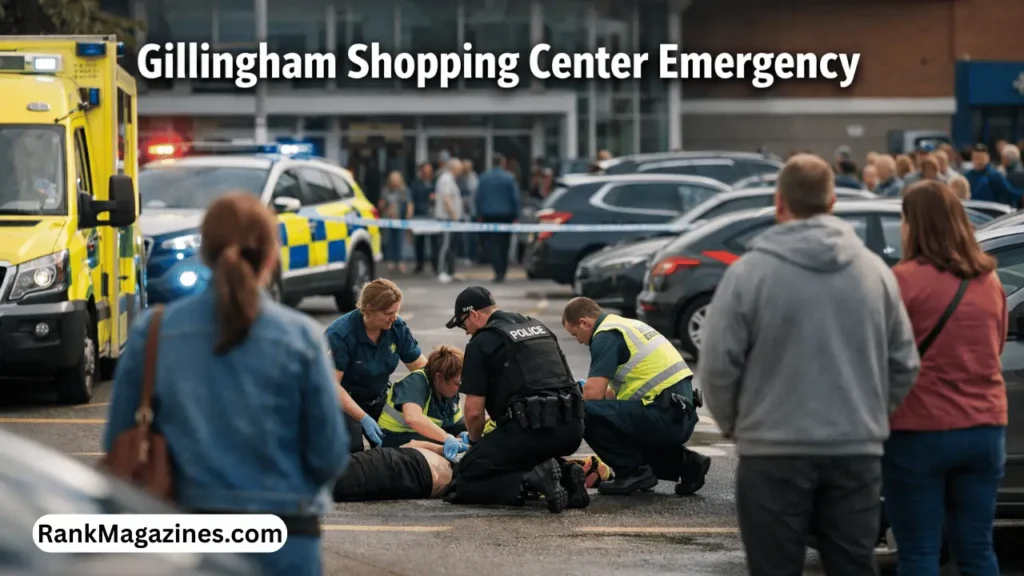
The gillingham shopping center emergency didn’t start with chaos. It started like any normal day—cars moving in and out, families walking between stores, nothing out of place. Then emergency services arrived, fast and visible, and everything shifted.
A medical emergency in a public car park escalated quickly. Despite a rapid response, a life was lost at the scene. That detail matters, not for shock value, but because it highlights a hard truth: even with trained responders on site within minutes, outcomes aren’t guaranteed.
What made the gillingham shopping center emergency stand out wasn’t just the incident itself. It was the setting. People expect danger on roads, in extreme weather, or during major events. They don’t expect it while picking up groceries or browsing clothing racks.
That disconnect is exactly why the reaction felt so intense.
The uncomfortable reality of emergencies in retail spaces
The gillingham shopping center emergency forced a spotlight onto something most operators prefer not to discuss openly—shopping centres are controlled environments, but only up to a point.
They rely on structure:
- predictable foot traffic
- clear entry and exit points
- surveillance systems
- trained staff presence
But none of that stops a sudden medical collapse. None of it prevents a fire from breaking out. None of it guarantees calm behavior when people sense something is wrong.
The gillingham shopping center emergency showed how quickly a controlled space can become reactive instead of proactive. One moment, everything runs on routine. The next, staff and security are making real-time decisions under pressure.
Why medical emergencies are the most dangerous blind spot
When people hear about a shopping centre incident, they often assume crime or fire. In reality, medical emergencies are far more common—and far less predictable.
The gillingham shopping center emergency is a clear example. There was no warning buildup, no suspicious activity, no visible hazard beforehand. Just a sudden crisis in a public area.
That unpredictability creates a serious challenge:
- staff may not immediately recognize severity
- bystanders may hesitate or panic
- emergency access can be slowed by crowds or parked vehicles
In a controlled environment, unpredictability is the one factor that breaks every plan.
And that’s exactly what happened during the gillingham shopping center emergency.
Emergency response looked fast—but speed isn’t everything
Emergency services responded quickly during the gillingham shopping center emergency. Police, ambulance crews, and support teams were on-site without delay. From an operational standpoint, that’s a success.
But response time alone doesn’t define effectiveness.
The real test is coordination:
- how quickly the situation is assessed
- how clearly information is communicated
- how well the area is secured without causing panic
In this case, the response contained the situation, but it also exposed how dependent outcomes are on factors outside control—timing, severity, and immediate access to the person in need.
The gillingham shopping center emergency didn’t fail because of slow response. It showed the limits of response itself.
Crowd behavior is the wildcard no one can manage
One of the most overlooked aspects of the gillingham shopping center emergency is how people reacted in real time.
Crowds don’t behave logically under stress. Even a small disruption can trigger:
- hesitation
- confusion
- sudden movement toward exits
- people gathering instead of dispersing
In a shopping centre, where space is shared and movement is constant, that behavior becomes unpredictable fast.
The gillingham shopping center emergency likely involved moments where bystanders didn’t know whether to stay, leave, or help. That uncertainty slows everything down, including access for emergency responders.
You can train staff. You can install systems. But you can’t fully control how hundreds of individuals react at once.
The role of infrastructure—and where it falls short
Modern shopping centres are built with safety in mind. Fire alarms, evacuation routes, surveillance systems—they’re all part of the design.
But the gillingham shopping center emergency didn’t involve a fire or structural issue. It happened in an open, accessible area. That’s where infrastructure has limits.
Car parks, entrances, and transitional spaces are harder to control. They’re not confined. They’re not monitored as tightly. And they’re often the busiest points in the entire complex.
That’s why the gillingham shopping center emergency didn’t unfold inside a store or corridor. It happened where movement is constant and control is weakest.
Why incidents like this linger in public memory
Not every emergency becomes a lasting talking point. The gillingham shopping center emergency did, and there’s a reason for that.
It challenged assumptions.
People don’t just visit shopping centres for convenience. They expect a level of safety that feels almost guaranteed. When something goes wrong in that setting, it feels more personal.
The gillingham shopping center emergency didn’t involve large-scale damage or multiple victims. But it still left an impact because it happened in a place tied to routine and normal life.
That contrast sticks.
What shopping centres need to rethink after this
The biggest takeaway from the gillingham shopping center emergency isn’t about response—it’s about preparation for the unexpected.
That means:
- staff trained beyond basic procedures
- faster internal communication systems
- clearer public guidance during incidents
- better control of open-access areas like car parks
More importantly, it means accepting that not every situation fits into a predefined protocol.
The gillingham shopping center emergency exposed the gap between planning for scenarios and facing real ones.
The gap between perception and reality
There’s a quiet assumption that public spaces are safer simply because they are organized. The gillingham shopping center emergency pushes back against that idea.
Order doesn’t equal control. Visibility doesn’t equal safety.
A shopping centre can look secure, feel calm, and still be one unexpected moment away from crisis.
That’s not a failure of design. It’s the nature of public space.
What individuals should take seriously
It’s easy to place responsibility entirely on management or emergency services, but the gillingham shopping center emergency also highlights the role of individuals.
Awareness matters. Not in a dramatic sense, but in small, practical ways:
- noticing exits
- recognizing when something isn’t normal
- responding calmly instead of reactively
During the gillingham shopping center emergency, every second and every decision—by staff, responders, and bystanders—contributed to how the situation unfolded.
Ignoring that reality doesn’t make future incidents safer.
The takeaway that shouldn’t be ignored
The gillingham shopping center emergency wasn’t dramatic in scale, but it was revealing in ways that larger incidents often aren’t. It showed how quickly routine breaks, how limited control really is, and how much depends on unpredictable human factors.
Public spaces aren’t as stable as they appear. They function well—until they don’t.
And when they don’t, the difference between order and chaos is thinner than most people are comfortable admitting.
FAQs
1. What triggered the gillingham shopping center emergency?
It was a sudden medical emergency in a public area, which escalated quickly and required immediate response from emergency services.
2. Was the response during the gillingham shopping center emergency considered effective?
The response was fast and coordinated, but the outcome showed that speed alone doesn’t guarantee a positive result in critical situations.
3. Why do medical emergencies cause more disruption than other incidents?
They are unpredictable, often unnoticed at first, and depend heavily on immediate access and quick recognition of severity.
4. Are shopping centre car parks less secure than indoor areas?
Yes, they are harder to control due to open access, constant movement, and less concentrated monitoring compared to indoor spaces.
5. What can individuals realistically do during such emergencies?
Stay aware of surroundings, avoid panic-driven reactions, and follow clear instructions from staff or emergency responders.
You May Also Read: Harouxinn: Digital Identity and Branding Strategy That Drives Online Influence