
Introduction
Most people think they already “get” chameleons: color change, slow movement, sticky tongue. That surface-level understanding is exactly why chameleónovité remain underestimated. The reality is sharper, more mechanical, and far more deliberate than the cartoon version. These animals are not passive background creatures; they are highly specialized predators built for precision, control, and survival in environments that punish hesitation.
The design of chameleónovité is not accidental
Every visible trait in chameleónovité serves a purpose, and none of it feels decorative once you look closely. The independently rotating eyes are not a gimmick—they eliminate blind spots entirely. One eye scans for threats while the other locks onto prey. That alone changes how they interact with the world compared to other reptiles.
Their feet don’t just “grip branches.” They clamp. The split structure functions like a biological tool, giving chameleónovité a level of control that makes even thin twigs usable pathways. Add a prehensile tail that works like a fifth limb, and you get an animal that treats vertical space as its default terrain.
Movement is another misunderstood feature. The slow, swaying walk is often mocked as clumsy. It’s the opposite. That motion mimics leaves shifting in the wind, allowing chameleónovité to move in plain sight without triggering predator attention. It’s not speed they rely on—it’s deception.
Color change is communication first, camouflage second
The obsession with camouflage misses the point. Yes, chameleónovité can blend into their surroundings, but that’s not the main event. Color change is a signaling system, and it’s far more expressive than people expect.
A male under stress doesn’t hide—he flashes stronger, darker tones. During encounters with rivals, chameleónovité escalate visually before anything physical happens. It’s a negotiation. Bright patterns signal dominance; dull tones can signal submission or low energy.
Temperature plays a role too. Darker colors absorb heat faster, which matters in cooler mornings. Lighter tones reflect heat when the day turns harsh. That means chameleónovité are constantly adjusting—not just reacting to threats but managing their internal state.
This isn’t random color shifting. It’s controlled, responsive, and often strategic.
Hunting is where chameleónovité outperform expectations
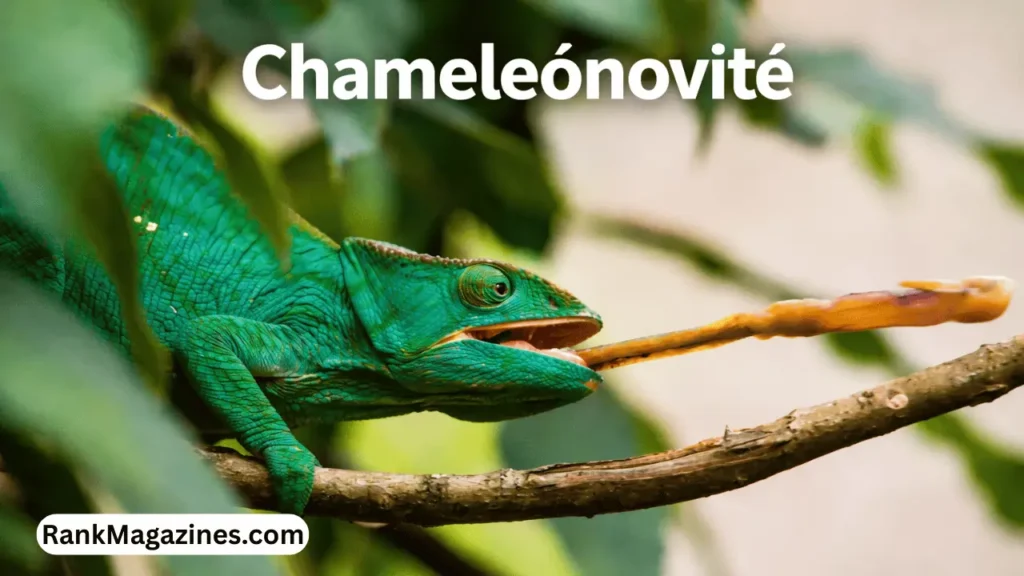
The tongue gets attention, but the mechanics behind it deserve more respect. When chameleónovité strike, it’s not a simple extension—it’s a rapid projection powered by stored energy in elastic tissues. The acceleration is extreme relative to body size.
What matters is accuracy. Chameleónovité don’t chase. They calculate. Distance, angle, and timing all come together in a single attempt. Misses cost energy, so precision matters more than frequency.
Larger species take it further. While insects are the staple, some chameleónovité will go after small vertebrates when the opportunity appears. That flexibility keeps them relevant across different ecosystems.
This is not a frantic hunter. It’s a patient one that commits only when the outcome is likely.
Madagascar isn’t just a hotspot—it’s the center of diversity
If you’re trying to understand chameleónovité, you can’t ignore Madagascar. The island holds a massive portion of their diversity, from tiny ground-dwelling species barely larger than a fingertip to larger, tree-dominant forms with elaborate crests and horns.
Isolation shaped that variety. With fewer competing reptile groups, chameleónovité expanded into niches that would be crowded elsewhere. That’s why you see extremes—miniaturization in one lineage and exaggerated physical features in another.
Outside Madagascar, chameleónovité still appear across Africa, parts of southern Europe, and into South Asia. But the density and variation drop. The island isn’t just another habitat—it’s where the family pushed its boundaries.
Small size doesn’t mean simple biology
The smallest chameleónovité are often dismissed because of their scale. That’s a mistake. Miniaturization comes with its own set of constraints, and these animals operate right at the edge of what’s physically viable.
Tiny species have reduced ranges, specific habitat needs, and tighter environmental tolerances. A slight shift in humidity or temperature can disrupt their survival. That makes them fragile in a way larger species are not.
Yet they maintain the same core features—independent eyes, projectile tongues, gripping limbs. Nothing essential is lost. It’s all compressed.
That alone tells you how fundamental those traits are to chameleónovité as a whole.
The myth of passivity needs to go
There’s a persistent idea that chameleónovité are passive or even lazy. It comes from how rarely they rush or display obvious bursts of activity. But energy conservation isn’t laziness—it’s efficiency.
Everything about their behavior suggests control. They don’t waste movement. They don’t chase what they can ambush. They don’t expose themselves without reason.
Even social interactions reflect this. Most chameleónovité are solitary by default, avoiding unnecessary encounters. When they do meet, especially during mating periods, the interactions are brief and often tense. Displays replace fights whenever possible.
This is not a species group built for chaos. It’s built for calculated survival.
Habitat choice shapes behavior more than people realize
Chameleónovité are often described as tree-dwellers, which is accurate but incomplete. Not all species stay above ground, and even arboreal ones adjust their position based on conditions.
In dense forests, chameleónovité use vertical layering to avoid competition and predators. Some stay higher in the canopy, others closer to the understory. In more open environments, they adapt by using shrubs or even ground cover when necessary.
Humidity, temperature, and vegetation density all influence where a chameleon positions itself throughout the day. These are not random shifts—they are constant adjustments to maintain balance.
That flexibility is part of why chameleónovité have spread across such varied regions.
Threats are real—and they’re not slowing down
Habitat loss is the biggest pressure on chameleónovité right now. Forest clearing doesn’t just remove trees; it removes the structural complexity they depend on. Without that layered environment, their advantages disappear.
The pet trade adds another layer of strain. Some species handle captivity poorly, yet they are still collected. That disconnect between demand and biological reality puts additional pressure on wild populations.
Climate shifts complicate things further. Since many chameleónovité rely on specific temperature and humidity ranges, even gradual changes can disrupt breeding cycles and survival rates.
This isn’t a distant problem. It’s already affecting distribution patterns.
What makes chameleónovité worth paying attention to
Plenty of animals are unusual. That alone isn’t enough. What makes chameleónovité stand out is how tightly their traits are integrated. Vision, movement, hunting, and signaling all work together in a way that feels engineered rather than accidental.
Take away one element—say, their eye independence—and the entire system weakens. The same goes for their grip, their tongue mechanics, or even their behavioral pacing.
They are not just interesting individually. They are interesting as a system.
And that’s where most casual explanations fall short.
Conclusion
If you reduce chameleónovité to color-changing reptiles, you miss the entire point. They are precision-driven animals that rely on control, not speed; strategy, not brute force. Every trait reinforces another, creating a system that works because nothing is wasted.
The real takeaway isn’t that they’re unusual. It’s that they’re efficient in a way most animals aren’t. And once you see that, it becomes hard to look at them as anything less than highly refined predators built for a very specific kind of survival.
FAQs
1. Why do chameleónovité move so slowly even when hunting?
They rely on stealth rather than speed. Slow movement prevents detection, allowing them to get close enough for a precise strike without alerting prey.
2. Can chameleónovité survive outside trees?
Some species can operate near the ground or in low vegetation, but most still depend on vertical structures for safety and hunting efficiency.
3. Do all chameleónovité change color the same way?
No. The intensity and range of color change vary by species, and some use it more for signaling than blending in.
4. Are chameleónovité aggressive toward each other?
They avoid direct conflict when possible. Visual displays usually settle disputes before physical fights happen.
5. Why are chameleónovité sensitive to environmental changes?
Their survival depends on narrow ranges of temperature and humidity, so even small shifts can disrupt feeding, movement, and reproduction.
You May Also Read: Mannacote: Precision Controlled Release for Soil Performance and Surface Protection