
Introduction
The situation around arkleston road renfrew emergency fault isn’t just a local inconvenience—it’s a visible crack in how infrastructure failures are handled, delayed, and quietly repeated. Road closures come and go, but what’s happening here has a pattern, and people living and commuting through Renfrew have started to notice it.
The incident didn’t come out of nowhere
The latest arkleston road renfrew emergency fault didn’t strike as a surprise to anyone paying attention. This stretch of road has already seen disruptions tied to structural strain, weather damage, and incidents involving nearby infrastructure. What pushed things over the edge this time was a failure underground—specifically a high-voltage cable that simply gave out.
That kind of failure doesn’t happen overnight. It builds over time, usually through a mix of aging systems, environmental pressure, and delayed upgrades. When the arkleston road renfrew emergency fault forced closures, it wasn’t just about fixing a broken cable—it was about dealing with something that had been deteriorating for years.
A ten-day disruption that felt longer
Closures linked to arkleston road renfrew emergency fault stretched for days, in some cases over a week. For daily commuters, that wasn’t a minor detour—it reshaped routines. Traffic didn’t just increase; it shifted unpredictably.
Drivers were pushed onto alternative routes like Renfrew Road and Gallowhill Road, both of which were never designed to absorb that volume of redirected traffic. Congestion built quickly, and travel times doubled for some.
What stands out is how quickly the situation escalated. One fault turned into a ripple effect across the local road network. That’s the real issue with arkleston road renfrew emergency fault—it doesn’t stay contained.
The real problem sits underground
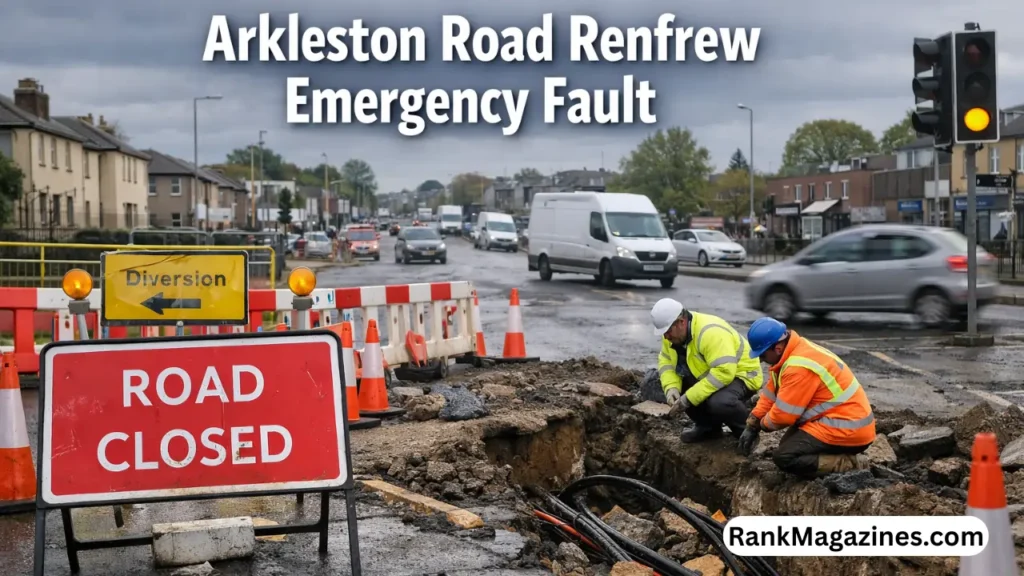
Most people only see the barriers, cones, and traffic signs. But the core of arkleston road renfrew emergency fault sits beneath the surface.
High-voltage cables run under roads like this for decades. They’re expected to handle pressure, temperature changes, and constant demand. But when they fail, the consequences are immediate and disruptive.
Repairing these systems isn’t straightforward. Engineers have to locate the exact fault point, isolate sections safely, and often replace large stretches of cable rather than a single damaged spot. In the case of arkleston road renfrew emergency fault, that meant digging up sections of the road and replacing hundreds of meters of infrastructure.
That’s not a quick fix. And it’s not cheap.
Why this road keeps coming back into the headlines
There’s a reason arkleston road renfrew emergency fault keeps resurfacing. It’s not just bad luck.
This stretch has already been hit by:
- Flooding that weakened the road base
- Structural stress linked to nearby motorway activity
- Accidental damage from external impacts, including bridge-related incidents
Each event chips away at the integrity of the infrastructure. By the time the cable failure happened, the system was already under strain.
What makes this frustrating is the reactive approach. Repairs happen after failure, not before. The arkleston road renfrew emergency fault could have been reduced—or even avoided—with earlier intervention.
Businesses paid the price quietly
While traffic delays get attention, local businesses take the deeper hit.
When the arkleston road renfrew emergency fault forced closures, access became a problem. Customers avoided the area. Deliveries slowed down. Foot traffic dropped almost immediately.
Unlike large chains, smaller businesses don’t have the buffer to absorb that kind of disruption. A week of reduced access can mean a significant drop in revenue.
And yet, their losses rarely make it into official updates.
Traffic management worked—but only just
Authorities did step in with diversion routes and temporary controls. Traffic lights, signage, and partial lane openings were introduced to manage the flow.
But the truth is, these measures were more about damage control than effective planning. The network wasn’t built to handle this kind of sudden redistribution.
During peak hours, the impact of arkleston road renfrew emergency fault was clear—long queues, frustrated drivers, and bottlenecks forming at predictable choke points.
It worked in the sense that it prevented total gridlock. But it didn’t solve the underlying issue.
The timeline tells its own story
The pattern around arkleston road renfrew emergency fault stretches beyond a single event.
Closures tied to infrastructure issues have appeared repeatedly across 2025 and into 2026. Each time, the cause varies slightly, but the result is the same: disruption, repair, reopening, and then another issue down the line.
One major repair phase involved replacing extended sections of underground cable, which took over a week to complete. And even after reopening, concerns remained about how long the fix would hold.
This isn’t a one-off repair cycle. It’s an ongoing maintenance problem being handled in segments.
What happens next doesn’t look simple
Looking ahead, the situation around arkleston road renfrew emergency fault isn’t likely to disappear quickly.
Large-scale infrastructure upgrades take time, planning, and funding. When repairs depend on wider motorway projects or regional planning decisions, delays become inevitable.
There’s also the question of whether current repairs are enough. Replacing damaged sections helps, but it doesn’t guarantee long-term stability if surrounding systems remain outdated.
In other words, the road may reopen—but confidence doesn’t return as easily.
A local issue with broader implications
It’s easy to treat arkleston road renfrew emergency fault as a localized disruption. But the pattern reflects something wider.
Urban infrastructure across the UK faces similar pressure—aging systems, increasing demand, and reactive maintenance strategies. When one section fails, it exposes the fragility of the entire network.
What’s happening here is just more visible because of how frequently it’s happening.
The bigger takeaway people are starting to notice
At some point, repeated failures stop being surprising. They start raising questions.
Why wasn’t the system upgraded earlier?
Why does each repair feel temporary?
Why do disruptions keep stacking instead of being resolved?
The arkleston road renfrew emergency fault has moved beyond being a technical issue. It’s now a case study in how infrastructure problems are handled when they’re allowed to build up quietly.
Conclusion
The story behind arkleston road renfrew emergency fault isn’t about a single cable failure or one stretch of road. It’s about what happens when maintenance is delayed, pressure builds, and fixes arrive only after disruption becomes unavoidable.
People don’t just want roads to reopen—they want confidence that they won’t close again next month for the same reasons. Right now, that confidence isn’t there.
And until the approach shifts from reactive repair to long-term planning, this won’t be the last time Arkleston Road makes headlines for the wrong reasons.
FAQs
1. Why does arkleston road renfrew emergency fault keep happening?
Because underlying infrastructure issues haven’t been fully addressed. Repairs fix immediate damage, but the wider system remains under pressure.
2. How long do closures usually last?
Major incidents have led to closures lasting around a week or more, depending on how extensive the underground damage is.
3. Are alternative routes reliable during closures?
They help, but they’re not built for heavy diversion traffic, so delays are common, especially during peak hours.
4. Who is responsible for fixing the problem?
Utility companies handle the cable repairs, while local authorities manage road closures and traffic control.
5. Will this issue be permanently resolved soon?
Not likely in the short term. Long-term stability depends on broader upgrades, not just isolated repairs.
You May Also Read: Fbiywpoeptoc: The Viral Internet Puzzle Driving Curiosity and Engagement